



Baran Baş
The Turkish Competition Board (the “TCB” or the “Board”), by its decision dated April 22, 2026, and numbered 26-15/434-162, decided to open a full investigation against Unilever Sanayi ve Ticaret Türk AŞ (“Unilever”) and Magnum Dondurma AŞ (“Magnum”) and imposed an interim measure.[2] The interim measure is based on the allegations that Articles 4 and 6 of Law No. 4054 on the Protection of Competition (“Law No. 4054”) have been infringed, and that the obligation imposed under the Board’s decision dated March 18, 2021, and numbered 21-15/190-80 (the “Unilever 2021 Decision”)[3] has not been complied with. The decision was published on the Turkish Competition Authority’s (the “TCA” or the “Authority”) website on May 18, 2026.
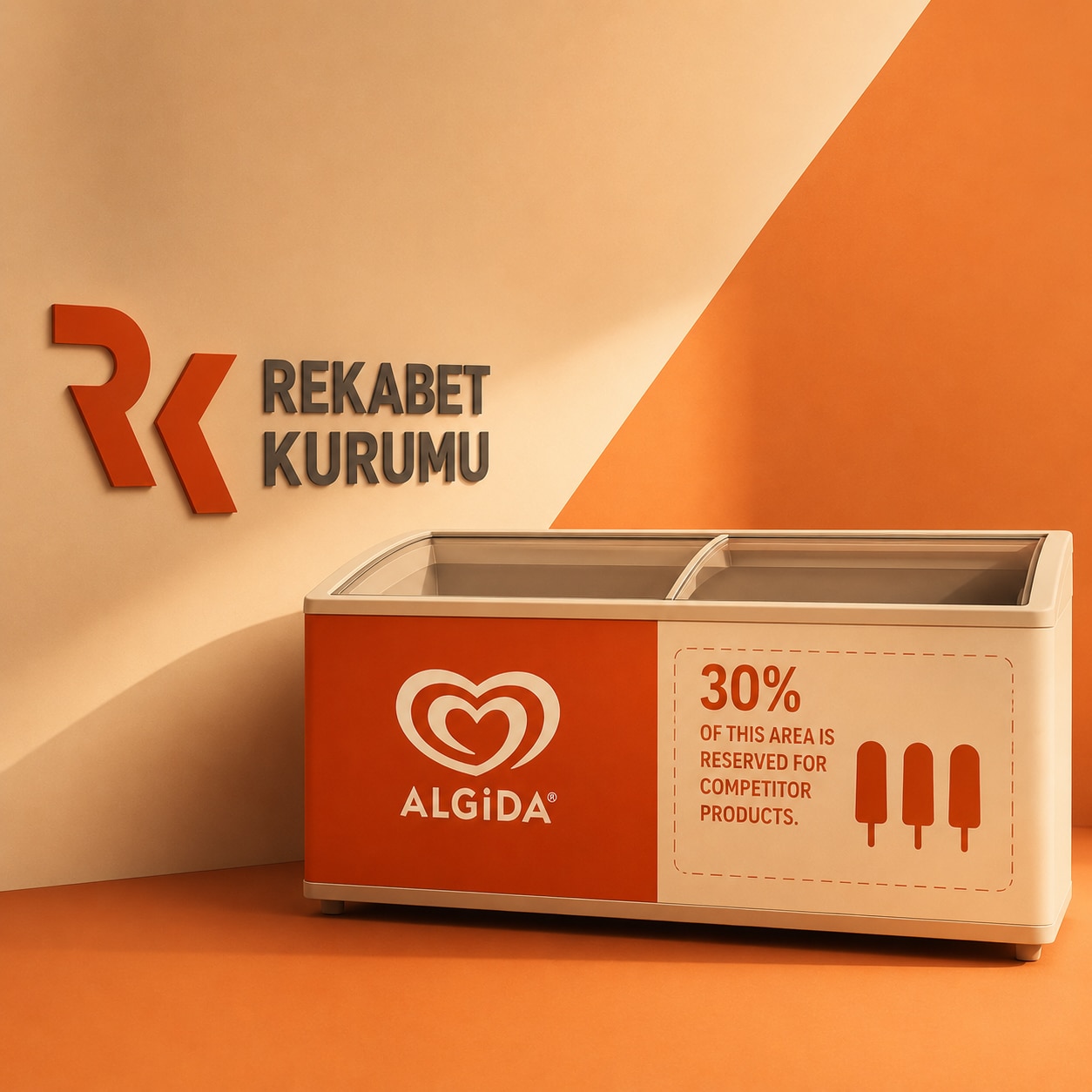
The interim measure rests on a key finding: the obligation imposed on Unilever (under the Unilever 2021 Decision), namely the requirement that Unilever, the dominant undertaking in the industrial ice cream market, open 30% of its freezer cabinets at points of sale to competitor products, has not produced the intended result over the nearly four-year period in which it has been in force.
This briefing examines the background of the decision, the legal framework governing interim measures, and the findings of the sector inquiry conducted in connection with the decision.

1. Background of the Decision and the Relevant Market
In its decision dated May 15, 2008, and numbered 08-33/421-147[4], the Board found that Unilever held a dominant position in the industrial ice cream market (and in its sub-markets). The Board further determined that the exclusivity clauses in the agreements concluded by Unilever and its distributors with points of sale, together with the practices that produced de facto exclusivity, prevented effective competition from forming in the relevant markets. On that basis, the Board imposed certain restrictions on Unilever’s dealings with final points of sale.
In the Unilever 2021 Decision, the TCB held that: (i) Unilever held a dominant position in the industrial ice cream market, in the impulse (immediate-consumption) ice cream market, and in the take-home ice cream market; (ii) Unilever had abused its dominant position through its discount practices, in violation of Article 6 of Law No. 4054; and (iii) Unilever had violated Article 4 of Law No. 4054 by including, in its agreement with Getir Perakende Lojistik AŞ (a Türkiye-based on-demand grocery delivery platform that distributes fast-moving consumer goods, including ice cream, to end consumers), a non-compete obligation prohibited under the 2008 decision. The Board also ruled that, at points of sale with a closed net sales area below 100 m² where no other freezer cabinet directly accessible to the consumer existed alongside the Unilever cabinet, the visible portion of the cabinet, as well as 30% of the total cabinet volume at the point of sale, must be arranged so as to allow the placement of competitor products.
In 2024, the Authority decided to launch a sector inquiry into the industrial ice cream market. The objectives of the inquiry were to assess the state of competition following the Unilever 2021 Decision and to verify whether Unilever was complying with the obligations imposed.
Industrial ice cream, the market on which the decision focuses, refers to products manufactured on a mass scale in large-scale facilities and placed on the market in specific packaging. In terms of consumption patterns, industrial ice creams are examined under three main categories: impulse (immediate consumption), take-home, and catering. In terms of distribution channels, the market is made up of two principal channels: the traditional channel, which includes outlets such as small grocery stores, kiosks, nut and snack shops, and mid-size markets; and the modern channel, which encompasses discount stores and supermarkets. According to the Nielsen data cited in the decision, a significant portion of sales takes place at small retail points of sale. At these outlets, the freezer cabinets used to display ice cream products are critical from a competition perspective: 83.7% of points of sale have only a single freezer cabinet, and nearly all of these cabinets are owned by the supplier undertaking.
With respect to Magnum’s position in the industrial ice cream market in Türkiye, the Board found that Magnum’s market share, on both volume and turnover bases, has remained high over the years, while its closest competitor, Golf, has steadily lost share. During this period, Panda, another branded-product manufacturer, also exited the market. The Board observed that, apart from a relatively limited competitive pressure in discount stores, no meaningful competition was observed in the other channels.
2. Findings on the Effects of the Unilever 2021 Decision on the Market
As part of the sector inquiry, meetings were held with competing undertakings, information and documents were requested from a large number of undertakings, and a survey was conducted with 2,000 points of sale across 26 cities of Türkiye.
According to the survey findings, 90.6% of points of sale that sell ice cream carry Algida-, Carte D’or-, or Magnum-branded freezer cabinets; roughly nine out of every ten points of sale have a Magnum cabinet. 15.7% of respondents reported that there was consumer demand for ice cream brands not sold at their point of sale. When this unmet demand is broken down, 61% of consumer requests related to Golf ice cream. Points of sale were also asked how consumers behaved when they could not find the ice cream they wanted. 72.7% of respondents stated that the consumer ended up purchasing products from one of the ice cream brands actually on sale. This data shows that visibility at the point of sale, and inside the freezer cabinet, directly shapes consumer preferences.
Turning to the practical impact of the measure imposed under the 2021 decision, the Board asked points of sale whether any competitor-brand products were present in their Magnum-branded freezer cabinets. 85.7% of points of sale answered that there were no competitor products in their Magnum cabinets. Among the reasons given for not stocking competitor-brand products, the following stand out: (i) 26.3%: Magnum offered a better commercial proposition; (ii) 13.3%: advantages such as free products, discounts, and rebates were provided in exchange for terminating cooperation with the competitor brand previously stocked; (iii) 5.9%: the freezer cabinet was reserved exclusively for the products of the cabinet owner; and (iv) 3.6%: Magnum pressured the point of sale not to sell other brands.
Points of sale were also asked whether they had ever attempted to place competitor-brand products in Algida freezer cabinets. Only 12.5% of points of sale answered in the affirmative. In addition, 23.3% of points of sale explained their reason for not placing competitor products as: “I gave up due to Algida’s reactions.”
The views submitted by competing undertakings reinforce this picture. In summary, competitors stated that: Magnum has pulled the sales season forward, moving sales that used to begin in January and February to December, and locks up points of sale before competitors are even active in the market; in January, a 20% promotional discount is layered on top of the existing 12% discount granted to points of sale; disproportionate advertising budgets and supporting promotions such as signage, awnings, and umbrellas make it harder to compete; placing two cabinets at points of sale below 100 m² restricts competitors’ access to those locations; and points of sale are visited frequently so that the cabinets are kept fully stocked.
The Board concluded that the 30% opening obligation imposed under the Unilever 2021 Decision did not have a meaningful effect on competition in the traditional channel, that Magnum’s market share in the traditional channel has, in fact, increased compared to the pre-2021 period, and that Magnum has continued to maintain its market leadership in the supermarket and discount-store channels. Concerns emerged that Magnum’s freezer cabinet and point-of-sale practices in the industrial ice cream market may have created exclusivity and foreclosed competitors. On this basis, the Board decided to open a direct full investigation into the allegations that Magnum has violated Article 4 or Article 6 of Law No. 4054.
3. Assessments Regarding the Interim Measure
Article 9(4) of Law No. 4054 provides that, where there is a risk of serious and irreparable harm prior to the final decision, an interim measure may be adopted. The measure must preserve the situation as it existed before the infringement and must not exceed the scope of the final decision. Four conditions must be cumulatively satisfied for an interim measure to be ordered: (i) a suspicion of infringement; (ii) the existence of a risk of serious and irreparable harm; (iii) the measure must be capable of preserving the pre-infringement situation; and (iv) the measure must not exceed the scope of the final decision.
In this file, the Board reached the conclusion that the requirement of a strong suspicion of infringement was satisfied based on three considerations. First, Magnum’s market share has increased, and its dominant position has been reinforced. Second, the data obtained in the sector inquiry shows that only 12.5% of points of sale attempted to place competitor products in Algida freezer cabinets, and 85.7% of points of sale had no competitor products in their cabinets; a significant share of those points of sale that did not stock competitor products attributed this to Magnum’s commercial offers, discounts, visual-material support, or direct interventions. Third, statements provided by competitors revealed that Magnum has not been acting in accordance with the Board’s 2021 decision: even the portion of the freezer cabinets opened to competitors has been refilled with Magnum products through promotions and discounts, and the sales season has been pulled forward in order to delay competitors’ entry into the market.
With respect to the risk of serious and irreparable harm, the Board took into account, in combination: the fact that freezer cabinet ownership in the market is predominantly held by Magnum; the fact that only 12.5% of points of sale have attempted to place competitor products in Magnum cabinets; Panda’s exit from the market; Golf’s long-term loss of market share; the increase in Magnum’s market share since 2018; and competitors’ statements that the Board’s decision has remained ineffective. On this combined basis, the Board concluded that there is a risk of serious and irreparable harm arising before the final decision is rendered.
Conclusion
The measure imposed by the Unilever 2021 Decision was, a “passive” opening obligation: it did not intervene in cases where the point of sale, of its own volition, chose not to place competitor products in the freezer cabinet. The interim measure imposed by the 2026 decision differs from the 2021 measure in three respects. First, the 30% area must be designated as a single, contiguous block and labeled accordingly; this ensures that the area is visually distinct, so that both the point of sale and the consumer can directly see to whom the area is allocated. Second, by closing the (30%) area within the freezer cabinet to Magnum products, the measure prevents the dominant undertaking from refilling the space with its own products through commercial incentives. Third, the obligation to leave the area empty where no competitor products are available transforms the space into an area reserved for competitors, regardless of the point of sale’s own preferences. The interim measure demonstrates that the Board considered the shift from a “passive” opening obligation to an “active” competitor-allocated-area measure (one no longer dependent on the will of the point of sale) necessary in order to restore competition in the relevant market.
The Board adopted the measure unanimously. The implementation features of the measure are as follows. Within one month of the notification of the reasoned decision, Unilever and Magnum shall: (i) reserve, for competitor products, 30% of the total volume of each cabinet, as a single contiguous block, at points of sale where no other freezer cabinet directly accessible to the consumer exists alongside the Unilever cabinet, accompanied by a label reading “This space is reserved for competitors’ products”; (ii) refrain from placing Magnum products in this area; (iii) increase this area up to 50% upon the point of sale’s request; and (iv) ensure that the relevant 30% area is left empty where no competitor products are available.
The practice of freezer cabinet exclusivity has long been on the EU competition law agenda. In its Van den Bergh Foods judgment, the CJEU held that a dominant undertaking’s imposition of a condition that only its own products may be stored in freezer cabinets provided free of charge to points of sale infringes Articles 101 and 102 of the TFEU.[5] In that respect, the Board’s approach is in line with the EU competition law case law on the Unilever group’s cabinet exclusivity practices.
Finally, it must be emphasized that the measure adopted is interim in nature, and that the principal full investigation is still ongoing. There is no doubt that, during the course of that investigation, Magnum’s freezer cabinet and point-of-sale practices will be examined in detail from the perspective of exclusivity and foreclosure. The design of the interim measure can be read as foreshadowing the more far-reaching measures that may be on the table in the final decision.
[1] Attorney Gülce Korkmaz is the external competition law consultant of Baş | Kaymaz Law Firm. After completing her master’s degree at Bilkent University, she is currently pursuing her doctoral studies in the field of competition law at the Faculty of Law of Lüneburg Leuphana University (Germany) as a PhD researcher with the scholarship of the Joachim Herz Foundation.
[2] TCB decision dated April 22, 2026 and numbered 26-15/434-162. For the Board’s reasoned decision on the case, please see here (only available in Turkish).
[3] TCB decision dated March 18, 2021 and numbered 21-15/190-80.
[4] TCB decision dated May 15, 2008 and numbered 08-33/421-147.
[5] CJEU, Van den Bergh Foods Ltd v. Commission, Case No. T-65/98, October 23, 2003, ECLI:EU:T:2003:281.
As Baş | Kaymaz Law Firm, we provide comprehensive competition law, advice and representation services to both national and multinational companies with our specialized and experienced lawyers.
If you have any questions on this topic or any matter related to Turkish competition law, you may contact us via [email protected].
